
Did you know that nearly 93% of all online experiences now begin with a search query? However, the way we find information has changed forever. With the rise of platforms like ChatGPT and Perplexity, the old rules of search engine optimization are no longer enough to keep your brand visible.
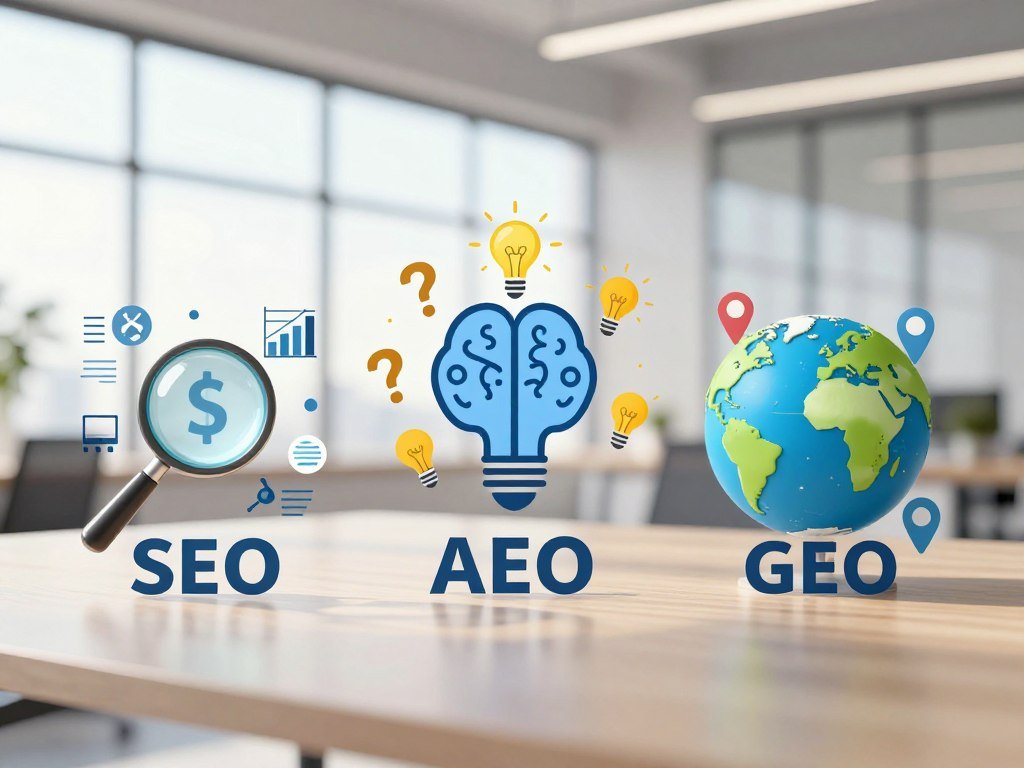
The digital landscape is shifting toward AI-driven results. This evolution has introduced new strategies that go beyond traditional methods. Understanding the differences between seo aeo geo is now vital for any business owner or marketer looking to stay ahead.
Navigating this new environment requires a fresh perspective on how customers interact with your content. By mastering seo vs aeo vs geo, you can ensure your business remains a top choice in an era of instant, AI-generated answers.
Key Takeaways
- Traditional search is evolving into AI-powered discovery.
- AEO focuses on providing direct answers to user queries.
- GEO prioritizes content that generative AI models find credible.
- Adapting to these changes is essential for modern digital visibility.
- Understanding these strategies helps you reach customers more effectively.
The Evolution of Search Engine Optimization
The world of SEO has seen a remarkable shift from its humble beginnings to the complex strategies employed today. This transformation reflects broader changes in how search engines operate and how users interact with them.
From Keyword Stuffing to Semantic Search
Initially, SEO practices were rudimentary, focusing on keyword stuffing and other manipulative tactics to rank higher in search results. However, as search engines evolved, so did their ability to understand the context and relevance of web content.
The introduction of semantic search marked a significant turning point. Semantic search allows search engines to better comprehend the intent behind a user’s query, providing more accurate and relevant results. This shift has necessitated a more nuanced approach to SEO, focusing on creating content that is not only keyword-rich but also contextually relevant and user-friendly.
The Impact of Algorithm Updates on Strategy
Algorithm updates have played a crucial role in shaping SEO strategies. Updates like Google’s Panda, Penguin, and BERT have forced SEO practitioners to adapt their techniques, moving away from manipulative practices towards more sustainable, user-centric approaches.
For instance, the BERT update significantly enhanced Google’s ability to understand natural language, further emphasizing the importance of creating high-quality, relevant content that matches user intent. As a result, SEO strategies now prioritize user experience, incorporating elements like dwell time, bounce rate, and content relevance into their optimization plans.
Defining SEO vs AEO vs GEO
The digital marketing sphere is witnessing a significant shift with the emergence of SEO, AEO, and GEO, each serving distinct purposes in the online ecosystem. To understand their impact, it’s crucial to define and explore these terms in depth.
What is Search Engine Optimization?
Search Engine Optimization (SEO) is the process of improving the visibility and ranking of a website in search engine results pages (SERPs) through various techniques and strategies. SEO focuses on optimizing website elements to make them more search engine-friendly, thereby increasing the quality and quantity of website traffic.
SEO involves understanding how search engines work, what people search for, and the keywords and phrases they use. It also includes optimizing website content, meta tags, and building high-quality backlinks to enhance a website’s authority and ranking.
What is Audience Engagement Optimization?
Audience Engagement Optimization (AEO) is a relatively new concept that focuses on optimizing content to directly answer users’ queries, particularly with the rise of voice search and direct answer boxes. AEO prioritizes creating content that resonates with the target audience, enhancing user engagement and experience.
AEO involves understanding the audience’s needs, preferences, and behaviors to create content that is not only relevant but also engaging. This approach is crucial in today’s digital landscape, where user experience is a key factor in determining the success of online content.
What is Geographic-based Optimization?
Geographic-based Optimization (GEO) is a strategy aimed at enhancing a website’s visibility in local search results. GEO is critical for businesses that rely on local customers, as it helps them appear in search results for location-specific queries.
GEO involves optimizing a website for local keywords, managing local listings, and ensuring consistency across the web. It also includes creating content that is relevant to the local audience and leveraging local SEO strategies to improve visibility.
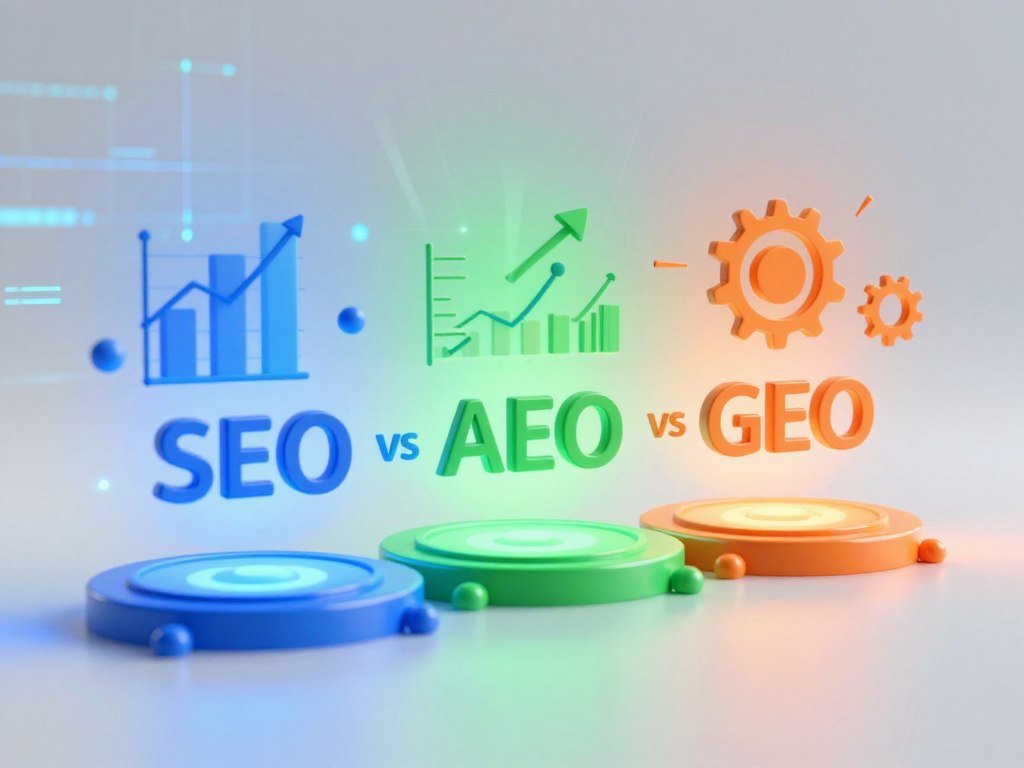
Understanding the differences between SEO, AEO, and GEO is vital for businesses to develop effective digital marketing strategies. While SEO focuses on search engine rankings, AEO targets direct engagement, and GEO enhances local visibility. Each plays a unique role in the digital marketing ecosystem.
Core Principles of Traditional Search Engine Optimization
Understanding the core principles of traditional SEO is crucial for developing an effective search engine optimization strategy. Traditional SEO involves a multi-faceted approach that includes on-page optimization, off-page authority building, and technical SEO.
On-Page Optimization Essentials
On-page optimization is the process of ensuring that each element of a webpage is optimized for search engines. This includes keyword research, optimizing meta tags, and using header tags effectively.
- Content Quality: High-quality, engaging content that addresses the user’s search intent.
- Meta Tags: Well-crafted title tags and meta descriptions that accurately describe the page content.
- Header Tags: Proper use of H1, H2, H3 tags to structure content.
Off-Page Authority and Backlink Building
Off-page SEO refers to actions taken outside of a website to impact its search engine rankings. The most significant off-page factor is backlink building, which involves obtaining high-quality links from other reputable websites.
- Guest Blogging: Writing guest posts for other reputable sites to build relationships and earn backlinks.
- Content Promotion: Promoting content through social media and other channels to attract links.
- Resource Pages: Creating resource pages that link to other high-quality sites, potentially earning backlinks.
Technical SEO Foundations
Technical SEO involves optimizing a website’s technical aspects to improve its visibility and ranking on search engines. This includes ensuring the site is mobile-friendly, has fast loading speeds, and is secure.
| Aspect | Description | Importance |
|---|---|---|
| Site Speed | Ensuring pages load quickly | High |
| Mobile-Friendliness | Ensuring the site is accessible on mobile devices | High |
| SSL Certificate | Installing an SSL certificate for a secure connection | High |
By focusing on these core principles, businesses can improve their search engine rankings and drive more traffic to their websites.
The Shift Toward Audience Engagement Optimization
The digital landscape is witnessing a significant shift towards Audience Engagement Optimization, emphasizing the need for content that resonates with human users. This shift is driven by the evolving nature of search engines, which are increasingly prioritizing user experience and engagement metrics.
As we transition into this new era of optimization, it’s crucial to understand the core principles that drive Audience Engagement Optimization. One of the key aspects is prioritizing user experience metrics, which involves understanding how users interact with your content and making data-driven decisions to improve engagement.
Prioritizing User Experience Metrics
User experience metrics provide valuable insights into how users engage with your content. By analyzing these metrics, you can identify areas for improvement and optimize your content to better meet the needs of your audience.
Some key user experience metrics to focus on include:
- Dwell time
- Bounce rate
- Scroll depth
- Click-through rate
The Role of Dwell Time and Bounce Rate
Dwell time and bounce rate are two critical metrics that can significantly impact your content’s performance. Dwell time refers to the amount of time a user spends on your page before returning to the search results, while bounce rate measures the percentage of users who leave your site without taking further action.
A high dwell time and low bounce rate generally indicate that your content is relevant and engaging, while a low dwell time and high bounce rate may suggest that your content needs improvement.
| Metric | High Value | Low Value |
|---|---|---|
| Dwell Time | Engaging content | Irrelevant content |
| Bounce Rate | Poor user experience | Effective content |
Creating Content That Resonates with Humans
Creating content that resonates with humans is at the heart of Audience Engagement Optimization. This involves understanding your target audience, their needs, and their preferences, and crafting content that speaks to them on a personal level.
To achieve this, focus on creating high-quality, engaging content that addresses the needs and concerns of your audience. Use storytelling techniques, incorporate visuals, and ensure that your content is informative, entertaining, or both.

Understanding Geographic-based Optimization for Local Success
In the realm of digital marketing, geographic-based optimization (GEO) has emerged as a vital component for local businesses seeking to improve their search engine rankings. As the digital landscape continues to evolve, businesses are recognizing the importance of tailoring their online presence to specific geographic areas to attract local customers effectively.
According to Google, “75% of consumers use search engines to find local information, with 61% of these searches resulting in a visit to a store within a day.” This statistic underscores the significance of GEO in today’s competitive market.
The Importance of Google Business Profile
A well-optimized Google Business Profile is foundational to any successful GEO strategy. It not only enhances visibility in local search results but also provides potential customers with essential information about your business, such as hours of operation, address, and contact details.
To maximize the effectiveness of your Google Business Profile, ensure that your listing is accurate, complete, and consistently updated. This includes responding promptly to customer reviews and using high-quality photos to showcase your business.
Local Citations and NAP Consistency
Local citations play a critical role in GEO by increasing your business’s online presence across various directories and platforms. Consistency in your business’s Name, Address, and Phone Number (NAP) across these citations is crucial for building trust with search engines and improving local search rankings.
- Ensure NAP consistency across all online platforms.
- List your business in reputable local directories.
- Monitor and manage your citations regularly.
Targeting Hyper-Local Keywords
Targeting hyper-local keywords is another effective GEO strategy. By incorporating keywords that are relevant to your specific geographic location, you can enhance your visibility in local search results and attract more targeted traffic to your website.
For instance, a business based in New York might target keywords like “New York coffee shop” or “coffee shop near Times Square.” This approach not only improves search engine rankings but also helps in connecting with the local audience more effectively.
By understanding and implementing these GEO strategies, local businesses can significantly improve their online visibility and attract more customers from their target geographic areas.
Key Differences in Search Engine Ranking Factors
To succeed in the digital landscape, it’s essential to grasp the differences in ranking factors that govern SEO, AEO, and GEO. Search engines use complex algorithms to rank content, and understanding these algorithms is crucial for developing effective optimization strategies.
The ranking factors can be broadly categorized into relevance, authority, and trust signals. While these factors are common across SEO, AEO, and GEO, their prioritization and implementation vary significantly.
How Algorithms Prioritize Relevance
Relevance is a critical ranking factor, as it ensures that search results match the user’s query. Algorithms assess relevance by analyzing content for semantic relevance, keyword usage, and contextual understanding. For SEO, relevance is often determined by how well the content matches the search query. In AEO, relevance is gauged by how engaging and relevant the content is to the target audience. GEO, on the other hand, prioritizes relevance to the local context and geographic location.
The Role of Authority in Different Frameworks
Authority is another vital ranking factor, as it indicates the credibility and trustworthiness of a source. In SEO, authority is often established through backlink profiles and domain trust. AEO places a strong emphasis on author credibility and the quality of content. For GEO, authority is linked to local citations and the consistency of business listings across the web.
Trust Signals and Their Impact
Trust signals are essential for building credibility with both users and search engines. These signals can include SSL certificates, user reviews, and content accuracy. In SEO, trust signals contribute to the overall authority of a site. For AEO, trust is built through transparent content and engagement metrics. GEO relies heavily on local reviews and the consistency of business information to establish trust.
Understanding these differences is key to optimizing content effectively across SEO, AEO, and GEO. By recognizing how algorithms prioritize relevance, authority, and trust signals, businesses can tailor their strategies to achieve better rankings and visibility.
Optimizing for Search Intent Across All Three Frameworks
To maximize visibility and engagement, it’s essential to optimize your content for search intent across all three optimization frameworks.
Understanding search intent is crucial because it allows you to tailor your content to meet the specific needs of your audience, whether they’re seeking information, looking to make a purchase, or navigating to a specific website.
Informational vs Transactional Intent
Search queries can be broadly categorized into informational and transactional intents. Informational intent is when users seek knowledge or answers to specific questions. On the other hand, transactional intent indicates that a user is ready to make a purchase or take a specific action.
For instance, a user searching for “best SEO practices” is likely looking for information, whereas someone searching for “buy SEO services” has a clear transactional intent. Optimizing for these different intents requires a nuanced approach to content creation.
Navigational Queries and Brand Visibility
Navigational queries occur when users search for a specific brand or website. For example, a search for “Facebook login” is navigational. Ensuring that your brand is visible for such queries is crucial for maintaining brand awareness and directing traffic to your website.
To optimize for navigational queries, it’s vital to have a strong online presence, including a well-optimized website and consistent branding across the web.
Mapping Content to the Customer Journey
Understanding the customer journey is pivotal in creating content that resonates with your audience at every stage. This involves mapping your content to the different stages of the buyer’s journey, from awareness to consideration and finally to the decision stage.
By aligning your content with the customer’s needs at each stage, you can improve engagement and ultimately drive conversions. For example, top-of-funnel content might focus on educating the audience, while bottom-of-funnel content could be more sales-oriented.
By optimizing for search intent across SEO, AEO, and GEO, you can create a comprehensive digital marketing strategy that not only improves your search engine rankings but also enhances user experience and drives meaningful engagement.
Technical Requirements for Modern SEO Strategies
Modern SEO strategies rely heavily on technical optimization to improve search engine rankings. As search engines continue to evolve, understanding and implementing the right technical SEO practices is crucial for online visibility and success.
Core Web Vitals and Page Speed
Core Web Vitals have become a key ranking factor, emphasizing the importance of user experience. Page speed is a critical component, as it directly affects user engagement and conversion rates. To optimize page speed, focus on image compression, minifying CSS and JavaScript files, and leveraging browser caching.
Tools like Google PageSpeed Insights can help identify areas for improvement. Ensuring that your website loads quickly and provides a seamless user experience is vital for both SEO and user satisfaction.

Mobile-First Indexing Requirements
With the majority of searches now coming from mobile devices, mobile-first indexing has become the norm. This means that Google predominantly uses the mobile version of your website for indexing and ranking. To comply, ensure that your website is mobile-friendly, with responsive design and fast loading times on mobile devices.
Key aspects to focus on include responsive images, mobile-friendly navigation, and ensuring that content is easily accessible on smaller screens.
Structured Data and Schema Markup
Structured data and schema markup help search engines understand the context and content of your website. By adding schema markup to your HTML, you can enhance your website’s visibility in search results through rich snippets and other enhanced search features.
Common types of schema markup include review schema, event schema, and business schema. Implementing these can improve your website’s appearance in search results and drive more targeted traffic.
Content Strategies for Better Audience Engagement
Effective content strategies are the backbone of audience engagement optimization, driving both visibility and interaction. To achieve this, it’s crucial to understand the core principles that make content resonate with humans.
Writing for People First, Search Engines Second
The primary focus should always be on creating content that is valuable and relevant to your audience. As Rand Fishkin, a well-known figure in the SEO industry, once said, “The best content is that which is so good, people would gladly pay for it.” This approach not only enhances user experience but also improves search engine rankings in the long run.
To write for people first, you need to understand their needs, preferences, and pain points. This involves conducting thorough audience research and creating buyer personas to guide your content creation process.
The Power of Interactive Media
Interactive media, such as quizzes, polls, and interactive videos, can significantly boost audience engagement. According to a study, interactive content generates twice as much engagement as static content. Incorporating interactive elements into your content strategy can make your brand stand out and encourage more meaningful interactions with your audience.
For instance, creating interactive infographics or hosting live Q&A sessions can provide value to your audience while also increasing engagement metrics.
Leveraging Social Signals for Engagement
Social signals, such as likes, shares, and comments on social media platforms, play a significant role in audience engagement optimization. Content that performs well on social media is more likely to be seen as relevant and valuable by search engines.
“The most important thing in communication is hearing what isn’t said.” –
Encouraging social sharing and engagement can be achieved by creating content that is not only informative but also entertaining or thought-provoking. Utilizing social media analytics tools can help you understand what types of content resonate best with your audience.
By focusing on these content strategies, you can enhance audience engagement, drive more visibility, and ultimately achieve your digital marketing goals.
Implementing Local SEO Strategies for Geographic Reach
Geographic reach is significantly enhanced through the implementation of tailored local SEO strategies. Businesses aiming to attract local customers must focus on optimizing their online presence to appear in location-based searches.
To achieve this, several key strategies come into play. Managing online reviews and reputation is crucial, as it directly impacts how search engines perceive the credibility and trustworthiness of a business.
Managing Reviews and Reputation
Online reviews are a critical component of local SEO. They not only influence potential customers but also affect search engine rankings. Encouraging satisfied customers to leave positive reviews on platforms like Google My Business can significantly boost a business’s local search visibility.
Responding to reviews, both positive and negative, demonstrates a business’s commitment to customer satisfaction and can mitigate the impact of negative feedback.

Localized Content Marketing
Creating content that resonates with local audiences is vital. This involves understanding local trends, events, and the specific needs of the community. By doing so, businesses can establish themselves as relevant and engaged members of the local community.
Localized content marketing can include blog posts about local events, guides to local services, or any content that incorporates local keywords and themes. This approach helps in attracting local traffic and increasing the business’s visibility in search results.
Optimizing for “Near Me” Searches
“Near me” searches have become increasingly common with the rise of mobile search. Optimizing for these searches involves ensuring that a business’s Google My Business listing is accurate and up-to-date, and that the website is optimized for location-based keywords.
By focusing on these local SEO strategies, businesses can improve their geographic reach and attract more local customers. It’s about creating a strong local online presence that resonates with both search engines and the local community.
Measuring Success in SEO, AEO, and GEO Campaigns
Measuring the success of SEO, AEO, and GEO campaigns requires a nuanced approach, tailored to each optimization strategy’s unique goals. Understanding the right metrics for each campaign is crucial for evaluating their effectiveness and making informed decisions to improve performance.
To effectively measure success, it’s essential to identify and track the most relevant metrics for each optimization strategy. This involves delving into key performance indicators (KPIs) for SEO, understanding engagement metrics for AEO, and analyzing local traffic and conversion data for GEO.
Key Performance Indicators for SEO
For SEO campaigns, key performance indicators are vital for assessing the success of optimization efforts. These include:
- Organic traffic growth
- Search engine rankings for target keywords
- Click-through rates (CTR) from search engine results pages (SERPs)
- Conversion rates from organic traffic
By monitoring these KPIs, marketers can gauge the effectiveness of their SEO strategies and identify areas for improvement.
Tracking Engagement Metrics for AEO
AEO focuses on enhancing user engagement, making metrics such as dwell time, bounce rate, and social shares critical. These indicators help marketers understand how well their content resonates with the target audience.
Dwell time and bounce rate are particularly important, as they signal to search engines whether the content is relevant and engaging. Higher dwell times and lower bounce rates generally indicate successful AEO strategies.
Analyzing Local Traffic and Conversion for GEO
For GEO, the focus is on local visibility and conversion. Key metrics include:
| Metric | Description |
|---|---|
| Local search visibility | How often a business appears in local search results |
| Local traffic | Visitors from geographically targeted areas |
| Conversion rates | Percentage of local traffic that completes a desired action |
Analyzing these metrics helps businesses refine their GEO strategies, improving local presence and driving more conversions.
Common Pitfalls When Balancing Multiple Optimization Approaches
The integration of SEO, AEO, and GEO into a unified strategy is fraught with potential pitfalls that can undermine even the most well-intentioned efforts. As businesses strive to optimize their digital presence across these multiple dimensions, understanding the common challenges is crucial for success.
Over-Optimizing and Keyword Cannibalization
One of the most significant risks when balancing multiple optimization approaches is over-optimizing. This occurs when the focus on SEO, AEO, and GEO leads to an excessive use of keywords, resulting in keyword cannibalization. Keyword cannibalization happens when multiple pages on a website target the same keywords, causing them to compete against each other in search engine rankings.
To avoid this, it’s essential to conduct thorough keyword research and strategically map keywords to specific pages. Here are some key strategies to prevent keyword cannibalization:
- Conduct thorough keyword research to identify unique keywords for each page.
- Map keywords to specific pages to avoid duplication.
- Use long-tail keywords to target specific search queries.

Ignoring Mobile User Experience
Another critical pitfall is ignoring the mobile user experience. With the majority of users accessing websites through mobile devices, a mobile-friendly design is no longer optional. Ignoring mobile usability can lead to high bounce rates, negatively impacting both SEO and AEO efforts.
To optimize for mobile, consider the following:
- Ensure a responsive design that adapts to various screen sizes.
- Optimize page speed, as slow-loading pages can deter mobile users.
- Simplify navigation to improve user experience on smaller screens.
Failing to Adapt to Local Market Nuances
Lastly, failing to adapt to local market nuances can significantly hinder the effectiveness of GEO efforts. Local search optimization requires an understanding of the local culture, preferences, and search behaviors.
To successfully adapt to local market nuances, businesses should:
- Conduct local market research to understand cultural and linguistic differences.
- Use locally relevant keywords and content.
- Engage with local communities through social media and other channels.
By being aware of these common pitfalls and taking proactive steps to avoid them, businesses can more effectively balance their SEO, AEO, and GEO efforts, leading to a more robust and resilient digital presence.
Tools and Technologies for Integrated Optimization
With the increasing complexity of search algorithms, companies are leveraging advanced tools and technologies to enhance their integrated optimization approaches. The right set of tools can significantly improve the efficiency and effectiveness of optimization strategies.
Analytics Platforms for Data-Driven Decisions
Analytics platforms play a crucial role in informing optimization decisions by providing insights into user behavior, traffic patterns, and content performance. Tools like Google Analytics offer a wealth of data that can be used to refine SEO, AEO, and GEO strategies. By analyzing metrics such as page views, bounce rates, and conversion rates, businesses can identify areas for improvement and measure the impact of their optimization efforts.
Keyword Research and Competitor Analysis Tools
Keyword research and competitor analysis are fundamental components of integrated optimization. Tools such as Ahrefs, SEMrush, and Moz provide comprehensive keyword research capabilities, allowing businesses to identify relevant terms and phrases that can drive targeted traffic to their websites. These tools also offer competitor analysis features, enabling companies to assess their competitors’ strengths and weaknesses and adjust their strategies accordingly.
Automation Tools for Local Management
For businesses with a local presence, automation tools can simplify the process of managing local listings, reviews, and citations. Platforms like Moz Local and BrightLocal help ensure consistency across the web, monitor local search rankings, and facilitate review management. By automating these tasks, businesses can maintain a strong local online presence with minimal manual effort.
By leveraging these tools and technologies, businesses can streamline their integrated optimization efforts, improve their online visibility, and drive more targeted traffic to their websites.
Future Trends in Search and User Experience
The search experience is on the cusp of a significant transformation driven by AI, voice search, and personalization. As technology continues to evolve, it’s essential to understand how these trends will shape the future of search and user experience.
AI-driven search results are becoming increasingly sophisticated, enabling search engines to provide more accurate and relevant results. According to a report by Google, AI-powered search results have improved the relevance of search outcomes by up to 30%. This shift towards AI-driven search is expected to continue, with machine learning algorithms playing a crucial role in enhancing search result accuracy.
The Rise of AI-Driven Search Results
AI is revolutionizing the way search engines operate, making them more intuitive and responsive to user queries. As
“The future of search is not just about retrieving information, but about understanding the context and intent behind the query.”
noted by a leading industry expert, the integration of AI in search is set to redefine the user experience.
The impact of AI-driven search results is multifaceted:
- Improved result accuracy through machine learning
- Enhanced user experience through personalized results
- Increased efficiency in information retrieval

Voice Search and Conversational Optimization
The rise of voice search is another significant trend shaping the future of search. With the proliferation of voice assistants like Siri, Alexa, and Google Assistant, users are increasingly using voice commands to search for information. This shift towards conversational search requires a different optimization strategy, focusing on natural language and long-tail keywords.
To optimize for voice search, businesses must consider the nuances of conversational language and the context in which users are searching. As conversational AI continues to advance, the importance of voice search optimization will only grow.
Personalization in the Search Experience
Personalization is becoming a critical component of the search experience. By leveraging user data and behavior, search engines can provide results that are tailored to individual preferences. This not only enhances the user experience but also increases the likelihood of converting searches into tangible outcomes.
The role of personalization in search is underscored by the fact that users are more likely to engage with content that is relevant to their interests. As search engines continue to refine their personalization capabilities, businesses must adapt their SEO strategies to account for this trend.
In conclusion, the future of search and user experience is being shaped by AI-driven search results, voice search, and personalization. By understanding and adapting to these trends, businesses can stay ahead of the curve and provide their users with a more intuitive and engaging search experience.
Building a Unified Strategy for Your Digital Presence
To dominate the digital space, businesses must adopt a unified strategy that encompasses SEO, AEO, and GEO. This approach ensures a cohesive online presence that leverages the strengths of each optimization technique.
Integrating SEO, AEO, and GEO into One Workflow
Integrating SEO, AEO, and GEO into a single workflow requires a comprehensive understanding of each discipline.
- SEO focuses on improving search engine rankings through technical optimization and content relevance.
- AEO prioritizes user engagement and experience, ensuring that content resonates with the target audience.
- GEO targets local search visibility, crucial for businesses with a physical presence.
By combining these strategies, businesses can create a robust online presence that attracts both search engines and users.
To achieve this integration, consider the following steps:
- Conduct thorough keyword research that aligns with your content and local SEO goals.
- Develop content that is not only optimized for search engines but also engaging for your audience.
- Ensure your website is technically sound, with fast loading speeds and mobile responsiveness.
Allocating Resources for Maximum Impact
Allocating resources effectively is crucial for the success of a unified strategy. This involves:
- Identifying key areas that require investment, such as content creation, technical SEO, and local listing management.
- Assigning tasks to team members based on their strengths and expertise.
- Utilizing tools and technologies that streamline processes and improve efficiency.
Continuous Testing and Iteration
Continuous testing and iteration are vital components of a unified strategy. This involves:
- Regularly monitoring performance metrics to identify areas for improvement.
- Conducting A/B testing to refine content and user experience.
- Staying updated with the latest algorithm changes and adjusting strategies accordingly.
By adopting a unified strategy and continuously testing and iterating, businesses can maintain a competitive edge in the digital landscape.
Conclusion
Understanding the nuances between search engine optimization, audience engagement optimization, and geographic-based optimization is vital for a robust digital marketing strategy. As discussed, SEO vs AEO vs GEO represent distinct approaches, each with its unique principles and applications.
A comprehensive strategy that integrates these elements can significantly enhance online visibility and engagement. By prioritizing user experience, local relevance, and search engine ranking factors, businesses can create a cohesive online presence that resonates with their target audience.
As the digital landscape continues to evolve, adapting to the changing requirements of search engine optimization, audience engagement optimization, and geographic-based optimization will be crucial for sustained success. By staying informed and agile, businesses can navigate the complexities of the online environment and achieve their marketing goals.
